
What is Republic Act No. 9225?
RA 9225, otherwise known as the Citizenship Retention and Re-acquisition Act of 2003, declares that natural born Filipinos who were naturalized in other countries could re-acquire or retain their Philippine citizenship after undergoing the procedure provided for under the law.
RA 9225 took effect on September 17, 2003 and is also commonly referred to as the Dual Citizenship Act. Philippine citizenship is re-acquired by taking the Philippine oath of allegiance before a duly authorized Philippine official, after submitting the required documents. This does not require one to renounce his allegiance to any other country.
What is the difference between retention and re-acquisition?
Those who were naturalized before the effectivity of RA 9225 or before 2003 were deemed to have lost their Philippine citizenship (under Commonwealth Act 63) and can re-acquire it under the same Act.
Those who were naturalized after the effectivity of RA 9225 or after 2003 were deemed to have kept their Philippine citizenship, in other words can retain it. However, to retain or re-acquire one’s Philippine citizenship one still has to undergo the same procedure of submitting the required documents and taking the Philippine oath of allegiance.
What is dual citizenship?
Dual citizenship means that you have two citizenships at the same time as a result of the interaction of the laws between two countries. A person can be a dual citizen by choice or by birth.
An individual can be considered a Philippine dual citizen by choice through the process of RA 9225, while a Philippine dual citizen by birth is a natural-born Filipino who does not have to perform any action to acquire the citizenships.
Who among the dependents of an applicant can apply for dual citizenship?
According to Section 4 of RA 9225, the unmarried child (legitimate, illegitimate or adopted), below 18 years old, of those who apply to retain or re-acquire dual citizenship shall automatically be considered citizens of the Philippines, upon the completion of the re-acquisition process of the applicant. They will no longer need to apply for Philippine Citizenship on their own provided that they are included in the parent’s application as they fall under the principles of derivative citizenship.
Derivative citizenship is the method of solely passing the citizenship of the parents to his/her children.
However, dependents above 18 years old or older, or even if he/she is not yet 18, but married, do not fall under derivative citizenship. He/she must individually apply to retain or re-acquire Philippine Citizenship in accordance with RA 9225.
What happens to the citizenship status of legal age child of former Filipino parents upon the latter’s re-acquisition of Philippine citizenship?
A child who is 18 years of age or above at the time of the parent’s re-acquisition of Philippine citizenship but was born when either parent was still a Philippine citizen, is considered to have been a natural born Filipino and may apply for recognition as a Filipino citizen on his/her own behalf. In addition, the applicant must show proof that either or both parents were Philippine citizens at the time of his/her birth.
For recognition as a Filipino citizen, click here for additional information.
What is the application process?
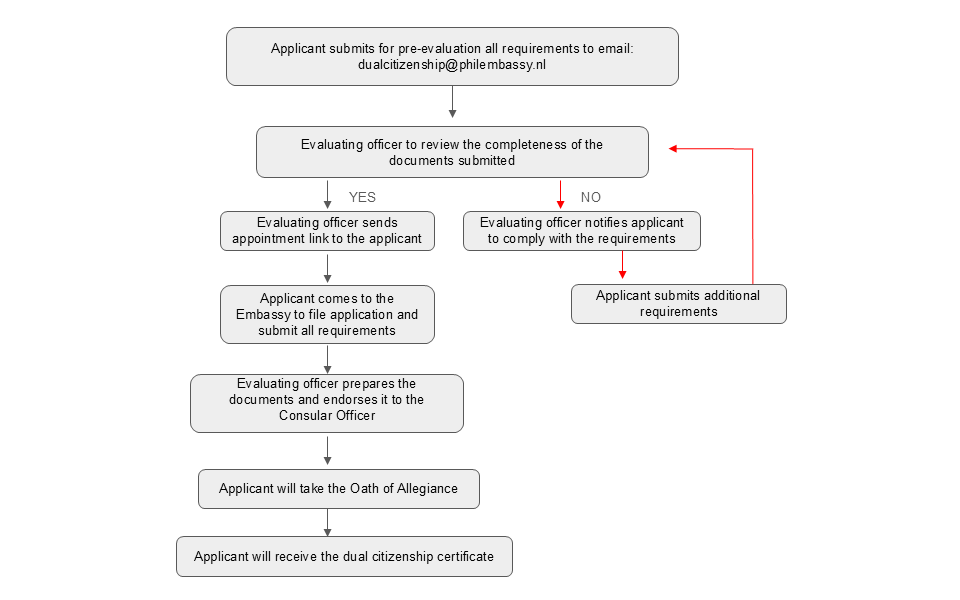
What are the requirements for the application of reacquisition/retention of Philippine citizenship?
Click here for the complete checklist of requirements. You may also send an email to This email address is being protected from spambots. You need JavaScript enabled to view it. , for further questions and clarifications.
What will happen after the application of dual citizenship?
You can take several actions to update your records with the Philippine government:
- Apply for a Philippine Passport. You have the option to get a Philippine passport.
Please note that the name on your passport will follow the name on your PSA documents.
Check the passport information page and complete the requirements before making an appointment. - Report Your Child’s Birth. For children born outside the Philippines, said vital event must be reported to the Philippine Statistics Authority (PSA) through the Embassy/ Consulate General with jurisdiction over the place of birth.
If your child is born in the Netherlands, you can check more information on the Report of Birth to this link or contactThis email address is being protected from spambots. You need JavaScript enabled to view it. for further information or clarification.
The Report of Birth can be used for the passport application up to one year from the date of registration.
If your child is born outside of the Netherlands, contact the Philippine Embassy/Consulate with jurisdiction on the country of birth of the child. (Click here for the directory of Philippine Foreign Service Posts). The Report of Birth will be used for the passport application. - Register for Overseas Voting. If the overseas voter registration period is open, you can register as an overseas voter on the same day you obtain dual citizenship.